Most real estate websites look good on the surface. They have clean design, property listings, and contact details. Yet very few of them generate consistent leads from Google.
The problem is not the website itself. The problem is how search engines and users experience that website.
Website SEO for real estate is not about tricks or technical jargon. It is about making your site useful, trustworthy, and easy to understand for both Google and real people. When done correctly, website SEO becomes a long-term lead asset, not just an online brochure.
This article explains how website SEO actually works for real estate, why most sites fail, and how it fits into a broader real estate SEO strategy.
Many real estate businesses invest in a website once and assume the job is done. Over time, the site becomes outdated, shallow, and disconnected from how buyers and sellers actually search.
Pages often target no real intent. Content stays generic. Location relevance is missing. The site looks fine, but it does not answer real questions.
Google does not rank websites for effort. It ranks them for usefulness. If your site does not clearly help buyers or sellers make decisions, Google has no reason to prioritize it.
This is where how real estate SEO generates leads becomes important. Rankings follow clarity, not design.
Design matters, but SEO does not start with design. It starts with understanding intent. As per Real Estate Research Data from Indian brand Equity Foundation ( IBEF) Demand is Increase in This industry.
Buyers and sellers rarely search for an agency name. They search for problems, situations, and locations. They want clarity before commitment.
They search to understand pricing, timelines, risks, and local conditions. A real estate website must be structured around these searches.
Website SEO works best when pages exist because someone is already searching for them, not because they “should” exist on a menu. This approach aligns website structure with the complete real estate SEO guide approach instead of surface-level optimization.
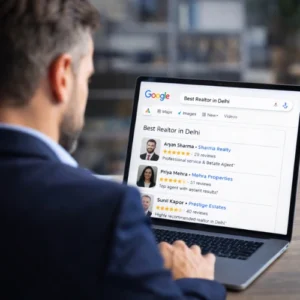
Real estate is local by nature. According to Optinmark Agency Experience A single generic service page cannot capture local search demand.
Strong location pages explain the area, lifestyle, buyer demand, seller expectations, and factors that influence property decisions. They feel real, not copied.
When location pages are thin or duplicated, rankings drop. When they are detailed and helpful, Google responds positively.
This is also where local SEO for real estate businesses connects directly with website SEO. Your website must support local intent clearly before Google Maps visibility becomes possible.
Listings alone do not build trust. They change, expire, and do not answer deeper questions.
Content does.
A website that ranks well explains the process clearly. It helps buyers avoid mistakes and helps sellers set realistic expectations. It guides instead of pushing.
When content answers real questions honestly, visitors stay longer. Google reads that behavior as a quality signal. Rankings improve naturally.
This is why content-led website SEO supports the real estate SEO fundamentals instead of relying only on listings.
Technical SEO helps, but it cannot save a weak website.
Speed, mobile usability, and structure matter, but they come after clarity. Search engines forgive small technical flaws if content is strong and relevant.
For real estate websites, simple technical hygiene combined with strong intent-based pages works far better than over-engineered SEO setups.
Many real estate websites have pages that exist in isolation. Google struggles to understand which pages matter most when nothing connects logically.
Internal linking solves this.
When buyer guides link to service pages, and location pages link to city pages, search engines understand hierarchy and relevance. Users also move more naturally from information to action.
Internal linking strengthens both SEO and conversions. This structure becomes even stronger when connected to Google Maps SEO for real estate, where website authority supports map rankings.
A common mistake is treating Google Business Profile and website SEO as separate tasks. They are deeply connected.
Your website supports your profile, and your profile reinforces your website. When content, locations, and services match across both, trust increases.
This connection plays a major role in ranking real estate business on Google Maps and converting local search traffic into calls.
Traffic without action is noise.
A real estate website should guide users toward the next step without pressure. That step could be a call, a form, or a consultation request.
When pages explain value clearly and make contact easy, conversions increase without needing more traffic. This is where real estate SEO services must align with website structure, not just rankings.
Paid ads stop when the budget stops in Real-estate Advertisement. Portals change rules. Social reach declines.
Your website is the only asset you fully control.
When website SEO is done correctly, old content keeps working. Location pages grow stronger. Cost per lead drops over time.
This is why serious businesses treat website SEO as a long-term growth system, not a one-time task.
At OptinMark, website SEO is not treated as a checklist. It is treated as a business strategy.
We focus on how buyers and sellers actually search, then build website structure and content to match that behavior. Local relevance, clarity, and trust come first.
Our goal is simple. Turn your website into a consistent source of qualified leads through website SEO services for real estate, not temporary traffic spikes.
A real estate website should do more than exist. It should explain, guide, and build confidence.
Website SEO makes that possible.
In competitive markets, the websites that win are not the loudest. They are the most helpful.
If you are unsure whether your website is helping or holding your business back, clarity is the first step.
👉 free SEO audit for real estate agents
We’ll show you what your website is doing right and where it needs improvement.
WhatsApp us